Custom AI Solutions: Why Discovery Workshops Are the Missing Link

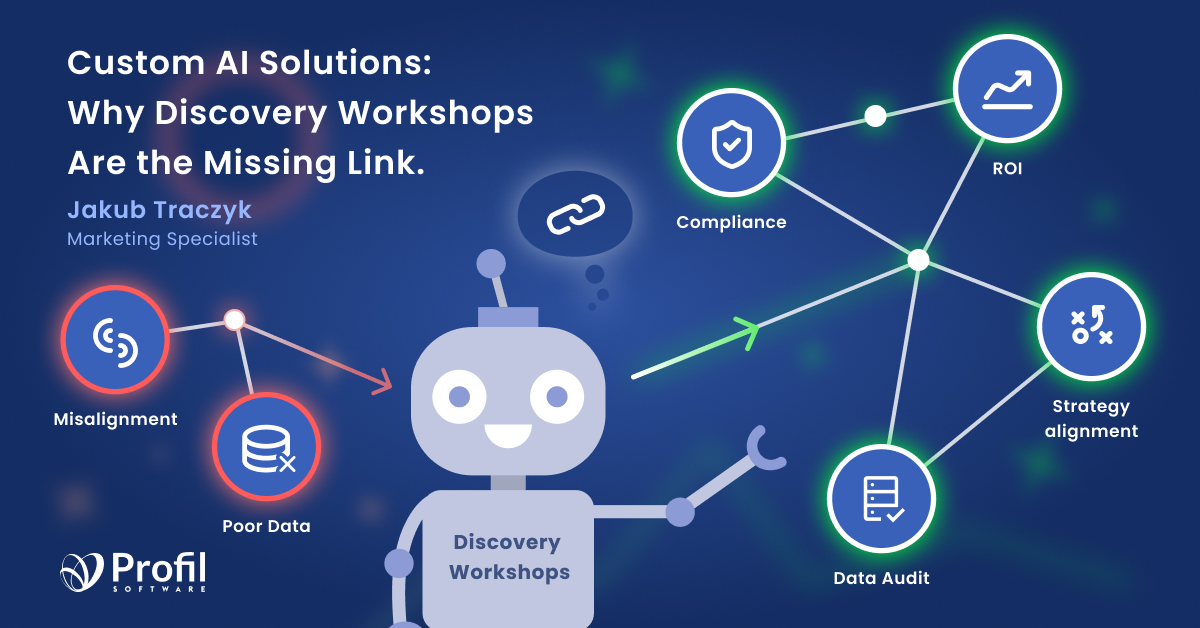
Table of Content
Quick answer (TL;DR)
A discovery workshop is a structured planning session that happens before any well-organized AI product idea moves into development. Between 80 and 85% of AI projects fail, and 30% are abandoned right after the proof-of-concept stage. The root causes are almost always the same:
- Poor data quality
- No clear strategy
- A gap between business goals and what the technology can actually deliver
What does a discovery workshop actually solve?
- Your data gets audited to check whether it is ready for AI
- ROI gets validated before any budget is committed
- EU AI Act compliance is built in from day one
- Business goals get aligned with what the technology can realistically deliver
Who needs it?
Everyone. Startups use it to avoid building the wrong thing. Mid-size companies use it to find real automation opportunities, and enterprises use it to align teams and make their AI strategy scalable. Skipping the discovery phase is, in reality, the most expensive shortcut you can ever take. Proper data preparation from the start makes a project three times more likely to succeed.
Introduction to Custom AI Solution
Custom AI solutions are about building a tool based on your needs, solving your problems and, most importantly, being aligned with your company and its resources. While basic tools are for everyone, a custom one is made for your specialized needs, specific product idea and business goals.
This lets you get better insights from your data and react faster to the market. It's key in competitive industries where standardized features shared across all tools aren't enough to stand out. Developing bespoke solutions creates unique capabilities and proprietary intellectual property that competitors cannot easily replicate. This kind of system really improves user satisfaction because it solves main problems for your customers. In short, you invest in something that gives long-term value and grows with your business.
The Strategy Gap: Why Traditional Development Fails to Scale AI
A discovery phase is a must-have. Recent reports show that about 30% of AI projects are dropped right after the PoC stage. Most of the time, this happens because of a bad strategy.
Here are the main reasons why projects fail:
- Most projects fail because the data is unprepared and unoptimized, so if it hasn't been cleaned up, the AI won't have anything useful to learn from.
- High costs: The total cost for custom AI can reach even a few millions. It’s hard to justify that kind of money without seeing the long-term value.
- The "vibe coding" trap: This refers to a situation where programmers simply change the code until it seems to work. Such a solution may pass a quick test, but is usually unscalable in the long run and requires numerous fixes.
A discovery workshop helps you avoid these mistakes and ensures the project actually hits your requirements.
This table shows the baseline risk of AI projects before discovery workshops, data validation, and a structured delivery process are applied.
Developing a custom AI solution involves defining a specific problem, gathering high-quality data, and training a specialized model. Proper planning at each key step is essential for success and plays a crucial role in ensuring the project aligns with business goals and avoids common causes of failure.
Why SDLC and PDLC are not enough?
To understand why the discovery phase is so important, you need to see the difference between building software and creating a whole product.
- The SDLC (Software Development Life Cycle) focuses only on the technical part, and how to write and test code.
- The product development lifecycle (PDLC) looks at the bigger picture of what we should build and why people will need it.
PDLC and SDLC don't really work for AI projects. Building artificial intelligence systems is fundamentally different from making regular software. You need to spend a lot of time cleaning data, training the model, and checking it constantly. Standard methods are too fixed for this. With AI, you have to be flexible and repeat steps many times until it works.
SDLC primarily emphasizes coding and testing but lacks processes to handle the complexities of AI data quality, model drift, and algorithm optimization. PDLC covers product vision and market fit, but often ignores AI challenges like regulations, ethics, and the fact that AI must always have access to new data to stay accurate and relevant.
Custom AI solutions also require close collaboration between business stakeholders and AI developers during the design phase. This makes sure they solve the right problems and support the business. Without this, projects often fail and waste resources. You might end up with a product that people don't want or that stops working when things change.
So, extending PDLC and SDLC with a dedicated discovery phase and iterative feedback loops is essential to successfully develop and deploy custom AI solutions that provide continuous improvement, sustainable value and scalability.
See how an AI Discovery Workshop works.
Discovery Workshops as the Solution
To fix the gap between the plan and the result, you should start with an AI discovery workshop that solves the problems of old software methods and turns simple testing into a real strategy. It makes sure your business goals match what the technology can actually do.
So how does it work in practice?
Step 1: Deep Analysis and Problem Understanding
The first step is analyzing why the business actually needs AI. The goal is to make sure it's a real tool that addresses customer needs and solves real business problems. All decision-makers must agree on clear goals. Once everyone is on the same page, there is an analysis of who the solution is for, what the main idea is, and how people will actually use it.
Step 2: Comprehensive Data Audit
This is a key part of discovery workshops that checks if the data is ready for AI implementation. That’s why first, it’s necessary to look at the volume and quality of the data. It means checking if there is enough good-quality data-usually at least 10,000 records with a high accuracy rate to start the process. Second, it checks for bias to make sure the data is fair and follows ethical standards, so the AI doesn't make unfair decisions based on old or incorrect information and doesn't start hallucinating.
Step 3: Evaluating Available Solutions and Selecting a Model
This part is about finding the right tool that is best suited for the specific tasks and needs of the individual project, while looking for a solution that works best instead of just chasing the newest models. Testing and optimization are critical phases in the development of custom AI solutions, ensuring accuracy and performance. In this phase, it is also checked if the AI can solve problems on its own or if it still needs a human. If it's a matter of human, the focus shifts to optimization and outsourcing harder tasks to more complex models, which reduces costs and makes the tool more independent.
Step 4: ROI and Business Case
This part is about showing the expected value of the project and checking if it meets the financial expectations of investors before spending any money. It uses simple formulas to compare the gains with the costs to build a strong business case. This accounts for direct savings like fewer work hours and other benefits like keeping more customers or making the company more flexible.
Step 5: Compliance and Regulations
Following the law is now a must for every project, which is why this part ensures the AI follows the EU AI Act and stays safe from the start. It includes keeping clear records to show how the model was built and what data was used. It also checks the risk level of the system to determine which specific legal rules must be followed for monitoring and safety.
Skipping the discovery phase might feel like you’re saving time and budget, but in the world of AI, it is usually the most expensive "saving" you can ever make.
Click to learn how product discovery helps set goals, define needs, and plan the next steps.
AI Laws: Ignorance is Expensive
In 2026, the discovery phase became a regulatory requirement. The EU AI Act, which entered into force in August 2024, mandates that “high-risk” AI applications must demonstrate transparency, human oversight, and strict risk management from the conceptual stage. In this case, high risk refers to any AI that bases its decisions on sensitive information, including things like company secrets or personal data of your employees. This means companies can build AI models that meet legal requirements like HIPAA or GDPR from the ground up, keeping their custom AI solutions fully compliant in every market they operate in.
Skipping compliance from the start can negatively affect your company's ROI. That's why the discovery phase is so crucial. It helps you make sure your custom AI solution is legal and easy to audit before you put any money into development. If you use banned AI tools or miss required documentation, fines can reach even €35 million, or 7% of your global revenue. Your AI roadmap should also cover data management, because without good data, your AI won't work the way you need it to.
It doesn't matter if you're a startup with just an idea or a large enterprise already using AI, a discovery workshop adds value at every stage.
Startups use it to avoid wasting money on the wrong solution before writing a single line of code. Mid-size companies use it to find which processes can be automated and where the real ROI is hiding, and whether custom solutions make more sense than adapting existing tools. Enterprises use it to get everyone on the same page and make sure their AI strategy can actually scale.
This isn't just theory. Gartner found that 60% of AI projects get dropped, not because the idea was bad, but because the data wasn't ready. McKinsey looked at companies investing heavily in AI and found that 92% are putting more money in, yet only 1% say their AI is actually working at full scale. The reason is almost always the same: they skipped the foundation and jumped straight to building. Research shows that doing data preparation properly from the start makes your project three times more likely to succeed. So a discovery workshop doesn't just help you avoid failure. It actively multiplies the return on every euro you invest.
There are no entry requirements for a discovery workshop. No minimum budget, no data science team, no technical background needed. The only real cost is skipping it, and that bill tends to arrive much later, when it's a lot harder to pay.
How Profil Software Solves the AI Implementation Gap
We built our AI discovery workshop around one simple idea - before you write a single line of code, you need to understand the problem and customer needs.
Our process is a structured, multi-session workshop where our AI engineers, UX designers, and business analysts work directly with you, turning a initial concept into a clear, costed, and realistic plan.
Every custom AI solution we've ever delivered started the same way - with questions. Because in a competitive market, a great idea isn't enough. You need technical expertise, the right technology, and a process that connects both to your real business needs.
Stage 1: Deep Process Analysis & Goal Alignment
Our first session covers everything that shapes the product development cycle from day one. It's also where concept development begins, in a focused working session, where every decision-maker is in the room.
We work through a fixed agenda:
- Business goals - What is our main goal, and how will we measure success?
- Global product vision - What exactly do we want to build, and what could get in our way?
- Users and stakeholders - Who uses the product, in what role, and what do they need from it?
- Constraints - What legal, organizational, and technical risks should we expect?
- Competitors and advantages - Market research, competitive analysis, and finding our edge.
At the end, we deliver three documents: a product vision board, an information architecture, and a prioritized list of functional requirements. They form the foundation for every decision made throughout the product development process.
Stage 2: AI Opportunity Identification
In session two, we take the requirements from stage 1 and find the right AI solution that fits your needs perfectly. That means figuring out what technology actually works for you - whether it's understanding human language, predicting trends, recognizing images, or building smart automated workflows. The goal is to address industry-specific challenges your competitors haven't cracked yet.
We look at:
- Whether to use existing tools or invest in custom solutions built specifically around your workflows.
- Which approach gives you the best results without making things too complicated.
- Can AI systems handle customer inquiries and everyday decisions on their own, or does a person still need to stay in oversight.
For example, in agriculture, custom AI models can assess crop health in real time, enabling smarter resource decisions. The same goes for manufacturing and healthcare, where AI is already proving its worth through automated visual checks and compliance tracking. But it only works when the solution is scoped the right way.
Stage 3: Technical Strategy & Architecture Planning
This is where the design phase begins and planning turns into real work. The technical team decides which tools and technologies to use, how data will flow through the system, and how everything stays secure. Implementation of a custom AI solution involves integrating it into existing systems with minimal disruption to operations. On the product design side, we focus on building an interface that drives user engagement and makes it easy to collect user feedback at every stage of the product.
We also handle legal requirements early on. If your product works with sensitive data like personal details, financial records, or medical information, we check how it fits under the EU AI Act. This way, you know exactly what rules apply before we start building anything.
Stage 4: Evaluation & Estimation
Our final session is about giving you decision clarity. We deliver a full report that includes:
- Clear solution summary, built on real market research and checked against actual customer satisfaction scores.
- Honest cost and time estimations.
- A product roadmap that takes you from early prototype to a successful product launch.
- Potential challenges, Risk flags and mitigation strategies.
- The testing and onboarding plan comes with clear KPIs, shaped by customer feedback we collect during the workshop.
Everything in this report is built on data-driven decisions.
The Value of Our Approach
Our workshop is built to make your product development budget go further and give your team the real-time insights they need to make smart decisions.
- Cost efficiency - Our workshops start at $2,500 and are designed to catch the problems that cause failures before they happen.
- Faster time-to-market - A well-run discovery workshop means fewer meetings, fewer misunderstandings, and less time wasted going back and forth.
- Long-term value - Because we document everything in the discovery phase, your team always knows where they stand and what needs to happen next.
AI is moving fast. The teams that succeed are the ones who truly understand the problem they're solving. Our workshop helps businesses turn a great idea into a clear, scalable plan - step by step. Every industry has its own challenges but asking the right questions early, with the right process and the right people, makes all the difference.
Is it necessary to have detailed analysis before attending a workshop, or can I come with just an idea?
Every great product starts with an idea, and Profil Software's workshops help you figure out your market and your users even if you're starting from zero. Building AI the right way means following a clear process, from first idea to product launch, with market research and customer needs guiding every step. Industries like healthcare, retail, finance, and logistics all have unique challenges that off-the-shelf tools with standardized features simply can't handle. That's where custom solutions win. A tailored solution fits your workflows, scales with your business, and delivers insights that actually matter to your goals.Why is standard Agile not enough for AI?
Regular Agile works well when you know what you're building and the code does exactly what you tell it to. AI is different, it's unpredictable, and what your model can actually do depends heavily on your data. That's why discovery comes first: you need to validate your data foundation before writing a single line of code.How does a Discovery Workshop help with the EU AI Act?
A Discovery Workshop helps you figure out where your AI fits under the EU AI Act. You map out the risks, decide what rules apply, and plan how to meet them from day one. That way, you're not scrambling to fix things after the product is already live.Can a workshop be useful if I already have documentation?
A workshop catches problems that would have never been spotted otherwise, including bad assumptions, missing data, and technical blockers hiding in plain sight.What is the main outcome I should expect?
You leave with everything you need to start optimizing your idea: a sharp vision for your product, an honest assessment of what's technically possible, a prioritized list of what to build first, a realistic budget, and a step-by-step roadmap so your team knows exactly what happens next.
Suggested blog posts
Find something interesting to read about
maschinelles Lernen